
- SAPpy Center
- Same Team, New Look
- “King [LeBron] ain’t got $#!t on me!!!” – Denzel Washington, Training Day
- If Video Killed the Radio Star, Modernity Killed the Sports Champion
- Avaya Stadium: What You’re Missing
- The Home Stretch
- Pitchers and Catchers
- The Warriors Wow
- The Seattle Seahawks Have Been Lying to You
- Harbaugh: a Preview of Coming Subtractions
Heavily Guarded
- Updated: March 8, 2011
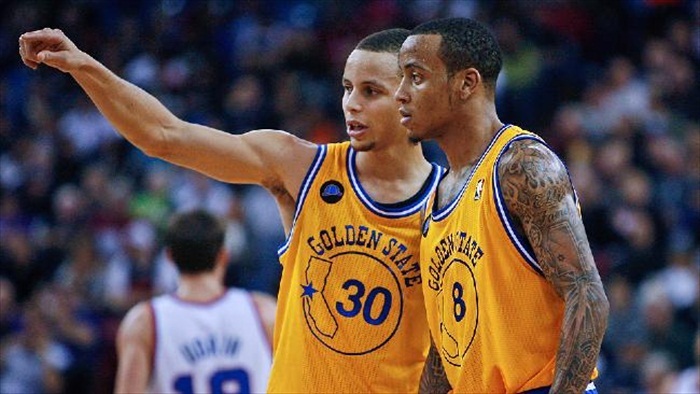
As the NBA has evolved over the last 10 years, we find teams progressively more reliant on their backcourts. The typical backcourt responsibilities have even bled into other positions – the hybridized “point forwards” of the league, or big men that can shoot the three and post up, for example. The abundance of backcourt players has led to the term “Elite Guard” getting tossed around with reckless abandon by writers, fans, and announcers alike. It seems every team has either an “elite guard,” or a guard blossoming into an “elite guard.”
We hate this term. Hate doesn’t even adequately describe it. We are repulsed and abhorred with severe odium by the term. It’s a buzzword that won’t die. It’s an over-used axiom used to bolster interest in decent players on struggling teams. That’s not to say there are not actually elite guards. We just want to know how one becomes “elite” at their position, and are there this many guards worthy of being put into the group? What exactly does “elite” mean, and how exactly should if translate into the NBA lexicon? Finally, how does the Golden State Warriors backcourt tandem stack up against these elite guards? The answers will probably surprise you.
It’s best to start this process from the ground up. This article is a long one, and gets a little “Bill Jamesy.” but it sets us up for evaluating each position as we move forward.
In Merriam Webster’s dictionary, (Yeah, we still own one of those.) elite is defined as “the choice or best of anything considered collectively, as of a group or class of persons.” We suppose it means that the guard position would be the “elite” position of the NBA. It’s not really true, see: LeBron James, Carmelo Anthony, et al who are considered to be the best players and are forwards. So the question remains – who is an elite guard? If the elite are the “best of anything considered collectively,” then there must be a top tier at either guard spot. There are 32 teams in the league, and every team carries at least 2 PG’s and 2 SG’s so we figured the top 3rd of the league is probably a fair (perhaps generous) way to establish the best. Beginning with the PG position, we needed to find a way to quantify the list.
Perhaps Wins and Losses? Here’s how that list shakes out:
- Tony Parker (Spurs 51-12)
- Rajon Rondo (Celtics 46-15)
- Jason Kidd (Mav’s 45-17)
- Derek Fisher (Lakers 45-19)
- Carlos Arroyo (Heat 43-20) Arroyo was the PG for most of the season, and Bibby only recently joined the team. No word on whether or not Bibby also blubbered on Sunday.
- Russel Westbrook (Thunder 39-22)
- Jameer Nelson (Magic (40-23)
- Mike Bibby (Hawks – 37-26) See note on Arroyo.
- Chauncey Billups (Nuggets 37-27) See note above, although Denver has played well with Lawson at the helm.
- Chris Paul (Hornets (37-28)
Obviously, this list is not the way to establish the crème de la crème. The inclusion of Derek Fisher and Carlos arroyo immediately eliminates it. In addition, there are far too many factors in a 48-minute game in a team sport to hold any one position responsible for a win or a loss.
Using the PG spot again, we wondered if it could be measured by assists per game.
- Rajon Rondo – 12.1 AST
- Steve Nash – 11.4 AST
- Deron Williams – 9.7 AST (Although he has averaged 15.7 since joining the Nets)
- Chris Paul – 9.6 AST
- Jose Calderon – 9.1 AST
- John Wall – 9.0 AST
- Raymond Felton – 9.0 AST
- Russell Westbrook – 8.4 AST
- Jason Kidd – 8.3 AST
- Derrick Rose – 8.1 AST
This list brings us closer, although it’s hard to imagine an elite list where an MVP candidate (Rose) is behind John Wall and Jose Calderon. Besides, a player is supposed to be the complete package, so ranking them based on one stat would seem to offset all other production statistics as less important. There is a metric that takes into account all recordable production statistics. It is wildly popular with sports writers, and it’s Player Efficiency Rating. It is very simply calculated.
EFF = ((Points + Rebounds + Assists + Steals + Blocks) – ((FG Attempts – FG Made) + (FT attempts – FT Made) + TO))
It seems simple, but the quandary with this equation is its inherent flaws. To receive a score of zero (a negative score is possible) a player merely has to shoot 33% from the floor, 25% on triples, and 50% on FT’s. If this stat line breaks you even, it means it is far too easy to achieve a top-level EFF; thus creating a glut at the top. In addition, blocks are not the equivalent of a point or a rebound in terms of game impact, and therefore dilute the importance of scoring and possession.
There is a book called “The Wages of Wins,” by David J. Berri, Martin B. Shmidt, and Stacey L. Brook that develop a metric called “Win Score” that is calculated as follows:
WS = Points + Rebounds + Steals + (.5*Assists) + (.5*Blocks) – FG Attempts –TO’s – (.5* FT Attempts) – (.5*Personal Fouls)
We are infinitely more enamored with this stat because it takes into account (and penalizes) for shots attempted. Inherently, the more shots needed to score points, the less efficient a player is. This equation allows for that. A player would have to shoot 50% from the floor, 33% from the arc, and 50% from the line to break even. That line is far more attractive (besides the FT %) than the one for EFF. The most accurate measure of a player’s efficiency (we’ve said efficiency a lot) would be WS48 – win score per 48 minutes.
WS48 = 48*WS/Mins Played
There it is the metric that we can get behind. It allows for all the production lines, penalizes for poor play (inefficient shooting, personal fouls) and creates a level sample in a league where minutes are a key component in compiling stats (A player who racks up 45 minutes is likely to score more points than a player playing 25).
The best point guards in the league would be getting the majority of the minutes in games (more than 50%), and will have appeared in at least half of the games to this point. Using Win Score, here is the top 10 list of this season’s PG’s who play 25+ minutes per game, and have appeared in 30 or more games.
- Chris Paul WS48 – 13.2
- Steve Nash WS48 – 12.6
- Jason Kidd WS48 – 11.1
- Rajon Rondo WS48 – 10.9
- Deron Williams WS48 – 10.0
- Stephen Curry WS48 – 9.5
- Russel Westbrook WS48 – 9.3
- Derrick Rose WS48 – 8.8
- Raymond Felton WS48 – 7.8
- Jose Calderon – WS48 – 9.4
We were shocked to see Steph Curry come in at number six on the list. How can he be ranked over two All Star players in Westbrook and Rose? We’ve contended all along that the W’s suffer from poor shot selection down the stretch, and a reliance on Monta and Steph to create off the dribble and make tough shots in traffic. It turns them into “volume scorers” (another term we don’t like); although, Curry is a better shooter and can get more jump shots than can Ellis
Upon further review, it makes sense against the WS equation. He plays in an offense dominated by Monta Ellis so he gets fewer shots; his minutes are down due to foul trouble this year (averaging 3.1 fouls/game), which means his production is coming in less time thus inflating his average. He is 93% from the foul line, and over 48% from the field (including 42.1% from distance. Westbrook and Rose both shoot 44% from the field and in the low 30’s from distance. We see how inefficient scoring can penalize a player here. In addition, we also see that no matter the metric used, the ageless Nash and Kidd are still playing at a high level.
Outside of Curry and perhaps Felton, there are not any real surprises here. The absence of Chauncy Billups perhaps, but that might be the only one.
One season could be a flash in the pan for a player, and we feel that to truly be considered amongst the elite, you must continue a high level of play over an extended period of time. It can’t be about one season (or ¾ of one, as we are using here). Dana “Double” Barros or Eldridge Recasner, anyone?
We extrapolated the WS48 over three years for each of the players on the above list. If you’ve maintained the highest level of production over three years, you have probably earned your place amongst the best of the best. It also eliminates someone like Curry from the list because he’s been in the league less than two years; and, despite his potential has not yet earned his stripes. A three year run showed that only five players appeared in the top 10 over three years. These same players appear in the top five two out of three years, with the only exception being when Jose Calderon came in at number 3 in ’09-’10. These players have demonstrated an ability to be productive and efficient over a number of years and based on the 3 Year Average Win Score, we feel the elite PG’s of the league are as such:
- Chris Paul – Average WS48 – 14.14
- Jason Kidd – Average WS48 – 12.76
- Steve Nash – Average WS48 – 11.59
- Rajon Rondo – Average WS48 – 11.21
- Derron Williams – Average WS48 – 9.92
Okay, Okay…Enough with the Statistics Class. What does this have to do with the Warriors?
Since the beginning of the Lacob/Guber Era, there has been much talk (both from fans and from Lacob himself) about turnover, and the acquisition of talent. The reason for this research is to try and discover who that is out there is an instant upgrade over the starting 5 of the W’s. There seems to be a superfluous amount of brazen demands and ideas for trades or player movement out there, and we wanted to measure just how necessary serious turnover might be.
Based on this WS metric, it appears that despite Curry’s growing pains as a burgeoning point guard (TO’s and PF’s at costly times), he has demonstrated an ability to produce at a very high level. His first two years in the league have placed him with the 7th best WS over those years, and among the six players above him, only Nash and Kidd will be Free Agents. Williams, and Paul have contracts that expire in 2012, and may be tradable assets, but without tradable draft picks, the Warriors have little chance to land a trade of such magnitude. In our minds, the most glaring point here is that amongst the “Elite Guards” in the Association, only two play on legitimate title contenders – Rondo, and Kidd. Neither of the teams Williams has played for have any illusions of being 2011 Champs, the Hornets are a few pieces away in a tough Western Conference, and Phoenix hasn’t been relevant in a few years.
Another interesting note: Tony Parker is the PG for the team with the league’s best record, and he isn’t even in the top 10 this year. It suggests that with a more productive point guard at this time, the missing piece for the W’s is not at the starting PG position, and time and energy is probably best spent elsewhere. Next week, we will examine the shooting guard position in the NBA, and where Monta falls amongst the league’s best.
Food for thought, for next week: if you had to choose between Monta or Steph. Who would it be? Our answer could surprise you!
TELL US WHAT YOU THINK! IS THIS STATISTIC BOGUS? DID WE LEAVE SOMEONE OFF? IS THIS A STEAMING PILE, OR AN ARTFULLY CRAFTED EXPOSE? DON’T BE SHY LEAVE A COMMENT!


0 Likes
0